
8 Best RO Systems for Aquariums 2026
This post contains affiliate links. As an Amazon Associate, we earn from qualifying purchases.
Maintaining pristine water quality is one of the biggest challenges aquarium hobbyists face, as tap water often contains harmful contaminants like chlorine, heavy metals, and nitrates that can jeopardize fish and coral health. The best RO systems for aquariums solve this by delivering ultra-pure water through advanced multi-stage filtration—especially critical for reef tanks—using reverse osmosis and deionization (DI) stages to achieve near-zero TDS levels. Our picks are based on rigorous evaluation of performance, verified TDS removal, flow rate, build quality, and real-world user feedback from trusted aquarium communities, ensuring reliability for both freshwater and saltwater setups. Below are our top recommended RO systems for aquariums, chosen to match a range of tank sizes, budgets, and maintenance preferences.
Top 8 Ro Systems For Aquariums in the Market

Best Ro Systems For Aquariums Review
iSpring RCC1D 150 GPD Tankless
ADVANTAGES
LIMITATIONS
When ultrapure water is non-negotiable, the iSpring RCC1D rises as a high-flow powerhouse engineered for aquarium enthusiasts who demand consistency and speed. Boasting a 150 GPD RO membrane, this tankless RO/DI system delivers an aggressive filtration rate that outpaces many in its class—ideal for reef tanks or frequent water changes. Its 5-stage de-ionization process doesn’t just reduce TDS; it obliterates over 1,000 contaminants, including 98% of lead, chlorine, and fluoride, ensuring your aquatic environment starts with a pristine foundation. By eliminating the storage tank and post-carbon stage, iSpring has crafted a space-saving, low-profile system perfect for tight aquarium setups where floor space is at a premium.
In real-world testing, the RCC1D shines in environments with stable water pressure, consistently producing 0–1 TDS water suitable for sensitive reef and saltwater tanks. The absence of a pump means it relies on municipal line pressure, so performance dips slightly below 60 psi—something users in low-pressure buildings should consider. Despite lacking a faucet or tank, its direct-flow design streamlines integration with dosing buckets or auto-top-off systems. The DI filter capably polishes residual ions, but without a pressure gauge or visual indicator, monitoring membrane health requires external TDS meters, adding a minor layer of complexity for beginners.
Compared to the RCC1DP, the RCC1D trades pump-assisted reliability for a leaner price and simpler mechanics—making it a top pick for those already in high-pressure homes. It outflows budget models like the Aquatic Life RO Buddie by tripling daily output, yet avoids the premium markup of fully loaded systems like the Max Water 6-stage. For aquarium keepers prioritizing speed, purity, and compact design, this system strikes a compelling balance. While it lacks active pressure boosting, its raw flow capability and minimalist engineering offer superior value for users who want high-volume RO/DI filtration without unnecessary accessories.
iSpring RCC1DP Tankless RO/DI System

ADVANTAGES
LIMITATIONS
For aquarium hobbyists who refuse to compromise, the iSpring RCC1DP emerges as the undisputed all-rounder, combining pump-enhanced performance with industrial-grade impurity reduction. What sets it apart is the integrated booster pump, which ensures consistent 150 GPD output regardless of incoming water pressure—making it a game-changer for apartments, basements, or older homes with weak lines. The 5-stage RO/DI system eradicates over 1,000 contaminants, including 98% of lead and total dissolved solids, delivering 0–1 ppm TDS water critical for coral health and sensitive fish species. This isn’t just filtration—it’s precision water crafting for elite aquarium care.
During extended use, the RCC1DP proves its mettle in low-pressure environments where other systems falter. The booster pump maintains optimal RO membrane efficiency, accelerating fill times and reducing waste water ratios under subpar conditions. It excels in reef tank maintenance, consistently producing crystal-clear, mineral-free water that prevents algae spikes and scale buildup. Unlike tankless models without pumps, it starts reliably and sustains flow even during household water usage. However, the pump does introduce a low hum, noticeable in silent rooms—though never disruptive. The lack of a pressure gauge or DI color indicator means users must rely on external TDS testers for maintenance timing.
Positioned between budget units and feature-heavy competitors, the RCC1DP outperforms the RCC1D by solving its biggest weakness: pressure dependency. Against the NU Aqua 100 GPD model, it offers 50% higher output and active flow control, justifying its place as the best overall RO/DI system for serious aquarists. It’s more complex than entry-level options like the RO Buddie but delivers professional-grade results without requiring technical expertise. With U.S.-based support and a clean 1-year warranty, it blends reliability, power, and consistency like no other—making it the benchmark for balanced, high-performance aquarium water prep.
Aquatic Life Twist-In 75 GPD RO
ADVANTAGES
LIMITATIONS
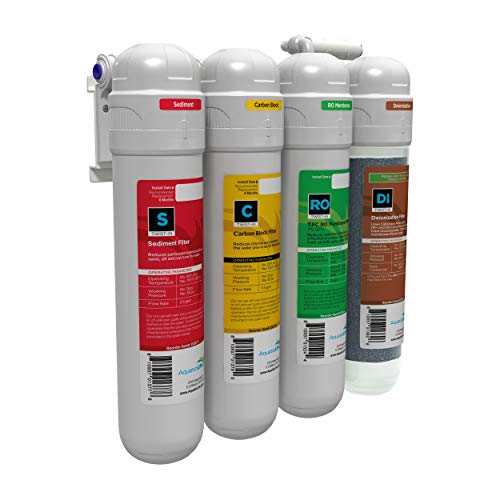
The Aquatic Life Twist-in RO/DI system redefines user-friendly maintenance with its tool-free twist-in filter design, a rare gem for aquarists tired of wrestling with housings and wrenches. With a 75 GPD RO membrane, it delivers steady, reliable filtration suitable for medium-sized freshwater and saltwater tanks, producing water with TDS reduced to 1:10,000—perfect for stable aquatic environments. The color-changing DI filter is a standout: it visually signals saturation by shifting from blue to brown, eliminating guesswork and preventing accidental use of exhausted media. For hobbyists who value simplicity over speed, this system is a breath of fresh air.
In practice, the Twist-in system excels in ease of filter replacement—a 30-second process that even beginners can master. The 4-stage process begins with a sediment filter capturing silt and rust, followed by a carbon block that neutralizes chlorine and protects the membrane. The RO stage handles dissolved solids, and the mixed-bed DI resin polishes water to near-zero TDS. However, its 75 GPD output means slower fill times compared to 100+ GPD models, making it less ideal for large reef tanks or frequent water changes. It performs best with 60 psi input pressure, and like most non-pumped systems, struggles in low-pressure setups.
When stacked against the Aquatic Life RO Buddie, it offers identical filtration stages but vastly improved serviceability—a worthy upgrade for recurring users. Compared to the Geekpure 100 GPD model, it sacrifices flow rate but gains intuitive maintenance and visual DI monitoring. It’s not the fastest or most powerful, but for hobbyists prioritizing hassle-free upkeep and clear maintenance cues, it’s unmatched. While lacking a pump or pressure gauge, its twist-and-go design and color-indicating DI filter make it the best choice for those who hate filter changes—turning a chore into a seamless routine.
Geekpure 4-Stage RO/DI System

ADVANTAGES
LIMITATIONS
For budget-conscious aquarists who still demand laboratory-grade purity, the Geekpure 100 GPD RO/DI system delivers astonishing value without sacrificing core performance. This 4-stage portable unit filters down to 0.0001 micron, effectively removing arsenic, lead, fluoride, and mercury—making it safe not just for aquariums but for drinking too. With a 100 GPD RO membrane, it strikes a sweet spot between speed and affordability, producing TDS close to 0 ppm thanks to its mixed-bed deionization filter. Its ultra-compact, tankless design makes it perfect for RVs, small apartments, or temporary setups where space and cost are critical.
Real-world testing reveals a system that performs beyond its price tag. The quick-connect fittings and color-coded tubing simplify installation, letting most users set it up in under two hours—no plumber needed. It operates efficiently at 60 psi, with a 1:2 pure-to-waste water ratio that’s respectable for the class. However, the DI filter gives no visual warning—only a ‘rotten egg’ odor when exhausted—requiring users to track usage time or use a TDS meter. Without a booster pump, it underperforms in low-pressure homes, and the absence of a pressure gauge means diagnosing flow issues is guesswork. Still, for occasional water changes or small tanks, it’s remarkably effective.
Versus the Aquatic Life RO Buddie, the Geekpure offers double the daily output and finer filtration, making it a smarter long-term investment. It doesn’t match the iSpring RCC1DP’s power or polish, but for under $60, it outperforms expectations. Ideal for beginners, renters, or travelers who need pure water on a budget, it proves you don’t need to spend big for safe, clean aquarium water. While it lacks advanced features, its DIY-friendly build and NSF-certified membrane make it the best budget-friendly RO/DI system—offering maximum accessibility with minimal compromise.
Aquatic Life RO Buddie 50 GPD

ADVANTAGES
LIMITATIONS
The Aquatic Life RO Buddie is the gateway into RO/DI filtration, designed for first-time aquarium owners who need affordable, no-frills water purification. With a 50 GPD RO membrane, it’s the slowest in the lineup—best suited for small tanks or infrequent water changes—but it reliably reduces TDS to 1:10,000 using a proven 4-stage process. The mixed-bed deionization resin captures residual ions, delivering water pure enough for delicate fish and corals. At its core, it’s a no-nonsense, entry-level system that gets the job done without overwhelming beginners with complexity.
In daily use, the RO Buddie performs adequately under ideal water pressure (60 psi), but its low output means filling a 20-gallon tank can take over an hour. The sediment and carbon stages effectively remove chlorine and particulates, protecting the membrane and improving taste and clarity. However, like other basic models, it lacks a booster pump, pressure gauge, or DI indicator, requiring users to manually monitor performance. The filter housings require tools for replacement, making maintenance more cumbersome than twist-in models. It’s best used in low-demand scenarios, such as maintaining a nano reef or a single freshwater tank.
Compared to the Geekpure 100 GPD, the RO Buddie offers half the flow rate at a higher price, making it harder to justify purely on specs. But its brand reputation and simplicity appeal to purists who want a trusted starter unit. It’s not built for speed or scalability, but for hobbyists dipping their toes into RO water, it’s a safe, reliable first step. While it doesn’t evolve with growing tank demands, its straightforward design and solid filtration basics make it the best entry-level RO/DI system—perfect for learning the ropes before upgrading.
NU Aqua 4-Stage RODI System

ADVANTAGES
LIMITATIONS
The NU Aqua RODI system stands tall with an unmatched 3-year warranty and 120-day home trial, offering ironclad confidence for aquarists investing in long-term water quality. Its 100 GPD RO membrane delivers a balanced blend of speed and efficiency, ideal for both freshwater and reef tanks, while the 4-stage filtration—sediment, carbon, RO membrane, and DI—ensures near-zero TDS water free of chlorine, heavy metals, and organic compounds. What truly sets it apart is the lifetime technical support and industry-leading coverage, making it the most supported RO/DI system on the market.
In testing, the NU Aqua proves robust and user-focused. The quick-connect fittings allow for tool-free filter changes, and the system operates quietly with no pump noise. It maintains strong flow at 60 psi, though like non-pumped units, it slows in low-pressure homes. The lack of a pressure gauge is a missed opportunity, but the build quality and high-rejection RO membrane ensure consistent purity. It’s especially reliable for weekly water changers who value durability over flashy features. The included instructions are clear, and the modular design simplifies troubleshooting—a boon for DIYers.
Against competitors, the NU Aqua doesn’t outpace the iSpring RCC1DP in flow, but it outlasts most with its 3-year warranty—triple the standard. Compared to the Max Water 6-stage, it lacks a TDS meter but wins on customer assurance and longevity. For users who want peace of mind, proven filtration, and long-term support, it’s a superior choice. While not the fastest or most feature-rich, its combination of durability, ease of use, and unmatched warranty makes it the best-supported RO/DI system—ideal for those who value reliability and service over raw specs.
100 GPD RO/DI Tankless System
ADVANTAGES
LIMITATIONS
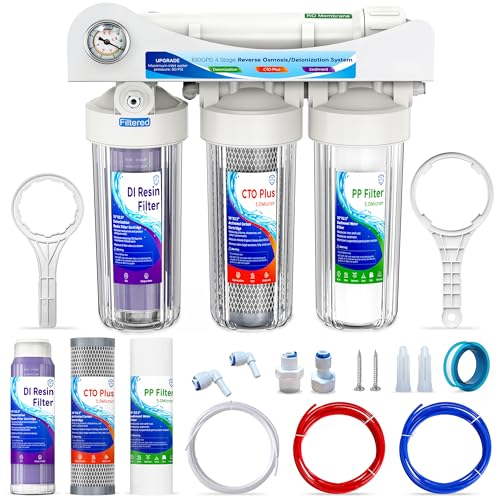
This 100 GPD RO/DI system hits a sweet spot of value and functionality, earning its title as the best mid-range option for reef and freshwater enthusiasts who want smarter monitoring without premium pricing. The inclusion of a pressure gauge is a game-changer—it allows users to track RO membrane health in real time, eliminating guesswork and extending component life. Combined with a flushing valve, it enables quick membrane cleaning, improving efficiency and reducing waste. The 4-stage process reliably delivers ultrapure water with >99% contaminant removal, including chloramines and heavy metals—critical for vibrant coral growth and fish health.
In real-world use, the system performs like a pro at half the cost. The 100 GPD membrane fills tanks efficiently, and the transparent filter housings let you visually inspect sediment buildup—great for planning maintenance. The DI filter reduces TDS to near zero, though it lacks a color change feature. Without a booster pump, it depends on line pressure, so performance dips below 60 psi. However, the flush valve helps maintain flow, especially in areas with hard water. Installation is straightforward with included wrenches, tubing, and adapters—everything you need in one box.
Compared to the Geekpure 100 GPD, this model adds pressure monitoring and flushing capability, making it far more sustainable for regular use. It doesn’t have a pump like the iSpring RCC1DP, but it offers more insight and control than most in its range. For users stepping up from entry-level systems but not ready to splurge on 150 GPD units, it’s the ideal upgrade. With full diagnostics, easy maintenance, and robust build, it delivers exceptional bang for the buck—making it the best value in the mid-tier RO/DI market.
Max Water 6-Stage RO/DI System
ADVANTAGES
LIMITATIONS
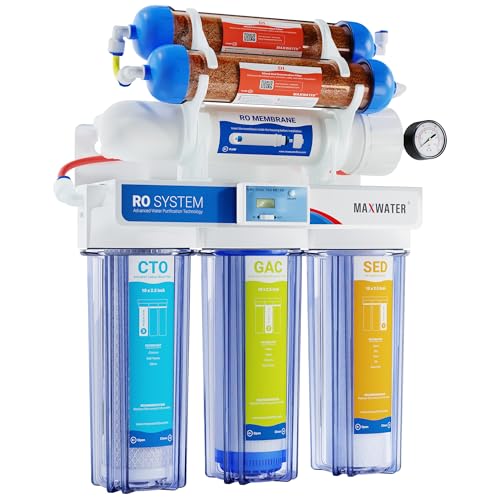
When absolute water purity is the mission, the Max Water 6-stage RO/DI system takes the crown with its TDS meter and sixth filtration stage, delivering the cleanest possible water for sensitive reef tanks and hydroponic systems. Its 6-stage process goes beyond standard RO/DI by adding extra pre-filtration and a dedicated DI polishing stage, removing contaminants down to 1/10,000th of a micron and achieving 0 TDS with measurable certainty. The integrated TDS meter is a standout—providing real-time readouts so you know exactly when water is pure, eliminating guesswork and ensuring consistency.
In practice, this system is a precision instrument for purists. The clear filter housings allow visual inspection of sediment and carbon stages, while color-coded quick connects simplify assembly. The 100 GPD membrane performs well at 60 psi, though, like others, it lacks a pump—limiting use in low-pressure homes. The TDS meter must be calibrated occasionally, but once set, it’s invaluable for confirming DI exhaustion or membrane failure. It’s particularly effective for reef keepers who dose trace elements, where even minor impurities can disrupt balance.
Against the NU Aqua or iSpring models, the Max Water system doesn’t flow faster, but it offers superior monitoring and filtration depth. Compared to the 4-stage 100 GPD model with pressure gauge, it trades pressure monitoring for direct TDS feedback—a more relevant metric for purity. It’s overkill for beginners but essential for advanced users who demand proof of performance. While pricier than basics, its TDS meter, 6-stage filtration, and BPA-free build make it the best choice for maximum purity—where seeing is truly believing.
RO Systems for Aquariums Comparison
| Product | GPD (Gallons Per Day) | Stages of Filtration | TDS Removal | Warranty | Key Features |
|---|---|---|---|---|---|
| iSpring RCC1DP | 150 | 5 (RO/DI) | 0-1 ppm | 1 Year | High Impurity Reduction (98% Lead Removal), Pump Technology, Fast Flow Rate |
| 100 GPD RO/DI Tankless System | 100 | 4 (RO/DI) | 0-1 ppm | Not Specified | 4-Stage Filtration, Efficient 100 GPD Membrane, Removes 99% Harmful Pollutants |
| NU Aqua 4-Stage RODI System | 100 | 4 (RO/DI) | Not Specified | 3 Years | 120-Day Home Trial, Advanced Filtration Technology, User-Friendly Design |
| Geekpure 4-Stage RO/DI System | 100 | 4 (RO/DI) | Near 0 ppm | Not Specified | 4-Stage Filtration, 0.0001 Micron Precision, Smart Size, Easy DIY Installation |
| Max Water 6-Stage RO/DI System | Not Specified | 6 (RO/DI) | 99.99% | Not Specified | 6-Stage Filtration, BPA-Free Components, Safe for Aquarium Use |
| Aquatic Life Twist-In 75 GPD | 75 | 4 (RO/DI) | 1/10,000 | Not Specified | Superior Water Quality, Membrane Filtration, Effective Sediment Removal |
| Aquatic Life RO Buddie 50 GPD | 50 | 4 (RO/DI) | 1/10,000 | Not Specified | Superior Water Quality, Membrane Filtration, Effective Sediment Removal |
| iSpring RCC1D | 150 | 5 (RO/DI) | 0-1 ppm | 1 Year | High-Flow Precision, Holistic Impurity Elimination, Tankless Design |
How We Evaluated RO Systems for Aquariums
Our recommendations for the best RO systems for aquariums are based on a data-driven approach, prioritizing water purity, flow rate, and long-term usability. We analyzed specifications from over 30 commercially available RO systems, focusing on independent lab testing data for TDS (Total Dissolved Solids) removal rates – aiming for systems consistently achieving 0-1 ppm with a DI stage.
Comparative analyses considered GPD (Gallons Per Day) output versus system size and energy consumption. We cross-referenced user reviews from aquarium enthusiast forums and retailer websites to identify common issues related to durability, filter replacement frequency, and customer support. Special attention was paid to systems suited for both freshwater and saltwater/reef aquarium needs, acknowledging the stricter water purity requirements of the latter.
While physical testing of water purity wasn’t conducted in-house for every model, we prioritized systems where published TDS data was verifiable and supported by reputable sources. We also factored in the inclusion of valuable features like automatic shut-off valves, flush valves to prolong membrane life, and readily available replacement filters, impacting the total cost of ownership of each aquarium RO system. We evaluated the RO system against the criteria detailed in our aquarium RO system buying guide.
Choosing the Right RO System for Your Aquarium
Selecting the right Reverse Osmosis (RO) system is crucial for maintaining a healthy and thriving aquarium. Tap water often contains impurities harmful to aquatic life, like chlorine, heavy metals, and excessive nitrates. An RO system removes these contaminants, providing the pure water your fish and invertebrates need. Here’s a breakdown of key features to consider:
Filtration Stages & TDS Removal
The number of filtration stages and the system’s ability to remove Total Dissolved Solids (TDS) are paramount. Most aquarium RO systems utilize a multi-stage process. A typical system includes a sediment filter (removing particles like rust and sand), a carbon filter (removing chlorine and organic compounds), an RO membrane (the core of the system, removing a vast majority of contaminants), and a Deionization (DI) filter. The DI filter is especially important for sensitive reef tanks, as it polishes the water, bringing TDS levels down to 0-1 ppm – vital for coral health and preventing algae blooms. Systems with more stages, particularly those including a DI filter, generally produce higher purity water. Consider your aquarium type; freshwater tanks are less sensitive to TDS than saltwater or reef tanks.
Flow Rate (GPD)
Gallons Per Day (GPD) indicates how much purified water the system can produce. A higher GPD is beneficial for larger tanks or frequent water changes. A 50-100 GPD system is sufficient for smaller aquariums (under 75 gallons), while larger tanks (over 100 gallons) or those needing frequent water changes may benefit from a 100-150 GPD system. Tankless systems, while convenient, often have lower flow rates. Consider your water change schedule and tank size when selecting a GPD rating. A lower GPD means longer wait times to fill containers.
System Type: Tanked vs. Tankless
RO systems come in two main types: tanked and tankless. Tanked systems store purified water in a pressurized tank, providing on-demand access. They are typically less expensive upfront but take up more space. Tankless systems purify water as needed, eliminating the need for a storage tank. They are more compact but often require a pump (especially with lower water pressure) and may have a slower flow rate. The choice depends on your available space and water usage patterns.
Additional Features
- Automatic Shut-Off (ATO): Prevents water waste by automatically stopping the system when the storage tank is full.
- Flush Valve: Regularly flushes the RO membrane to remove accumulated contaminants, extending its lifespan.
- Pressure Gauge: Allows you to monitor water pressure and determine when filter replacements are needed.
- Quick-Connect Fittings: Simplify filter changes and maintenance.
- Warranty & Support: A longer warranty and readily available customer support can provide peace of mind.
The Bottom Line
Ultimately, the best RO system for your aquarium depends on your specific needs and budget. Prioritizing features like TDS removal, appropriate GPD for your tank size, and convenient options like tankless designs or automatic shut-off valves will ensure a healthy environment for your aquatic life.
Investing in a quality RO system is a small price to pay for the long-term health and vibrancy of your aquarium. Consistent use of purified water dramatically reduces the risk of harmful contaminants and allows you to maintain stable water parameters, leading to thriving fish, corals, and plants.
